ABC Florida East Coast Chapter Press Release
FOR IMMEDIATE RELEASE
Inside the Classrooms Building South Florida’s Future: ABC Florida East Coast Chapter Offers a Look at the Training Powering the Region’s Construction Decade
As Miami-Dade, Broward, and Palm Beach counties enter a generational stretch of building activity, the Coconut Creek-based chapter pulls back the curtain on how tomorrow’s electricians, HVAC technicians, and jobsite leaders are made
COCONUT CREEK, FL — July 3, 2026 — Walk past any tower crane in downtown Miami, any hospital expansion in Broward, or any logistics park rising along the Palm Beach County corridor, and you are looking at the finished product of something that began years earlier in a classroom: a decision by an ordinary South Floridian to learn a trade.
The ABC Florida East Coast Chapter, operating from its corporate office at 3730 Coconut Creek Pkwy in Coconut Creek, has spent decades turning those decisions into careers. Now, with the region facing what economists describe as a generational run of construction activity, the chapter is offering the public an inside look at how its programs actually work — what students experience, how instruction is structured, which trades are surging, and why the organization’s graduates have become some of the most sought-after hires in the tri-county labor market.
A Decade of Work Already on the Books
Forecasting is always uncertain, but South Florida’s construction outlook rests on foundations that are unusually solid. The projects are not hypothetical — many are already permitted, financed, and scheduled. Residential developers hold entitlements stretching years into the future. Public agencies have committed funding to roads, bridges, water systems, schools, and transit. Hospitals and universities have published expansion master plans. And the ongoing work of hardening the region against wind and water — new roofs, impact glazing, elevated systems, upgraded drainage — represents a permanent, recurring category of demand rather than a passing cycle.
Layered on top of all of it is maintenance: every structure built during the current boom will require skilled hands to service, renovate, and eventually modernize it. In practical terms, a young person entering the trades in South Florida today is stepping onto an escalator of demand that extends beyond the horizon of their working life.
“The question we hear from parents is always the same — will this career still be there in twenty years?” said a spokesperson for the ABC Florida East Coast Chapter. “Look around the region and the answer is self-evident. You cannot offshore the installation of an electrical system. You cannot automate the replacement of a rooftop chiller. The work is here, it is growing, and it must be done by trained people standing on South Florida soil.”
What a Student Actually Experiences
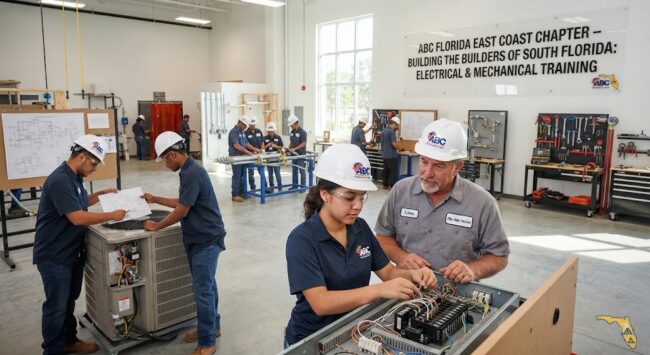
Much of the chapter’s appeal lies in the concreteness of its instruction. Prospective students often arrive imagining rows of desks and textbooks; what they find instead is a blend of applied classroom learning and genuine field practice that mirrors the rhythm of the industry itself.
A typical apprentice’s week runs on two tracks. By day, the apprentice works full-time for a sponsoring contractor — pulling wire in a rising office core, setting equipment on a hospital mechanical floor, framing, fitting, finishing — earning a real paycheck and logging documented on-the-job hours under the supervision of experienced journeymen. By evening, on scheduled class nights, the apprentice reports for structured instruction that explains the “why” behind the day’s “how”: code requirements, system theory, mathematics, print reading, materials science, and safety doctrine.
The two tracks reinforce each other continuously. A concept introduced in Tuesday’s class appears on Wednesday’s jobsite; a problem encountered on the jobsite becomes Thursday’s classroom discussion. By graduation, students possess something neither a university nor a jobsite alone can confer — thousands of hours of paid experience fused with a complete theoretical education, all validated by nationally recognized credentials.
This integration is the signature of the chapter’s So Fl construction vocational training classes, which follow standardized national craft curricula while drawing constantly on the projects, codes, and conditions specific to South Florida. Students learn hurricane tie-down requirements, corrosion-resistant practices for coastal environments, and the heat-safety protocols that subtropical jobsites demand — regional knowledge that generic online courses simply cannot replicate.
The Instructors Make the Difference
Every program lives or dies on the people teaching it, and here the chapter draws from a deep well: its faculty is composed of tradespeople and field leaders who built their reputations on South Florida projects before stepping into the classroom. Students are taught conduit bending by electricians who have wired high-rises, refrigeration cycles by technicians who have commissioned hospital chillers, and jobsite safety by professionals who have managed it on live projects.
The effect on students is tangible. Questions get answered with stories from real jobs. Mistakes get corrected the way a foreman would correct them — directly, practically, and with the reasoning attached. And when a student struggles, the instructor has usually seen that exact struggle before in a dozen prior apprentices and knows precisely how to work through it.
Class cohorts themselves become professional networks. Apprentices train alongside peers employed across dozens of different contractors, building relationships that follow them through decades in a regional industry where reputation and connections shape opportunity.
Spotlight: The Electrical Pathway
Among all the chapter’s offerings, none faces more explosive demand than the electrical program. The commercial projects defining this era of South Florida development — data centers with their immense power requirements, medical facilities with redundant critical systems, smart buildings laced with low-voltage controls, and the charging infrastructure spreading through parking structures region-wide — are, at their core, electrical undertakings.
The chapter’s electrical training for commercial construction in South Fl takes students through a multi-year progression that begins with electrical theory, safety, and basic installation and advances through raceway systems, conductor sizing, transformers, motor controls, grounding and bonding, and the National Electrical Code mastery on which the entire craft rests. Later years introduce the specialized knowledge commercial work demands: distribution equipment, emergency power systems, fire alarm fundamentals, and the coordination skills required on dense, multi-trade projects.
Employer demand for graduates is intense and shows no sign of softening. Commercial electrical contractors across the tri-county market describe qualified journeymen as their single scarcest resource, and compensation reflects it — the electrical trade consistently ranks among the region’s best-paid crafts, with licensure and contracting opportunities extending the ceiling further for those who pursue them.
Spotlight: The Mechanical and HVAC Pathway
If electricity is the nervous system of South Florida’s buildings, climate control is their circulatory system — and in this climate, it never stops working. Cooling in the region is not seasonal comfort but continuous necessity: server rooms, operating theaters, laboratories, groceries, hotels, and offices all depend on mechanical systems running around the clock, every month of the year.
The chapter’s HVAC training for commercial construction in South Fl prepares students for that reality with a curriculum spanning refrigeration theory, air distribution and duct design principles, hydronic systems, commercial rooftop and split systems, chillers and cooling towers, building controls, and the brazing, recovery, and charging skills of daily practice. Students prepare for EPA Section 608 certification — the federal credential required to handle refrigerants — and learn the energy-efficiency and indoor-air-quality standards that modern commercial specifications increasingly require.
The trade’s economics are compelling in a distinctive way: HVAC work combines new-construction demand with a vast, permanent service-and-replacement market. Even in construction slowdowns, South Florida’s existing equipment keeps aging, failing, and requiring skilled attention — making the mechanical trades among the most recession-resistant careers the industry offers.
One Institution, Every Trade, Every Stage
Electrical and HVAC headline the current surge, but the chapter’s catalog reaches across the industry — plumbing, carpentry, and additional crafts — alongside a full ladder of safety credentials and supervisory education. That breadth positions the organization as a comprehensive school for construction work in South Fl rather than a single-trade academy: a place where a family can send one child toward electrical work and another toward mechanical systems, where a company can develop laborers into journeymen and journeymen into superintendents, all under one institutional roof.
The stacking of credentials is deliberate. A graduate never reaches a dead end; each completed program unlocks the next. Safety cards lead into apprenticeships, apprenticeships into journeyman standing, journeyman standing into foreman and leadership coursework. Alumni return years after their first class to add the next credential, and employers plan employee development around the sequence.
That architecture — combined with graduate outcomes measured in employment, wages, and safety records — is why contractors and workforce professionals across the region so consistently name the chapter the top school construction training in South Fl has produced. The ranking is not self-awarded; it is conferred, hire by hire, by the companies who choose its graduates first.
The Employer’s Side of the Equation
For the contractors of South Florida’s merit shop community, the chapter functions as something close to a shared workforce department. Member companies sponsor apprentices, sit on curriculum committees, host classroom visits, and recruit directly from graduating cohorts. Many maintain standing relationships in which every new field hire is routed through chapter training as a condition of advancement.
The business case is straightforward. Contractors who invest in structured construction worker training South Florida employers can verify see the returns on their own projects: fewer incidents, less rework, faster schedules, and — critically in a market where talent is the constraint on growth — retention. Workers whose employers fund their education stay longer, advance internally, and become the supervisors who train the next generation in turn.
The arrangement also solves a collective problem no single company could address alone. No individual contractor can rebuild a regional labor pipeline; a chapter representing hundreds of them can. By pooling training through one institution, South Florida’s merit shop industry has effectively built itself the workforce engine its order books require.
Answering the Skeptics: The Trades Versus the Degree
The chapter’s staff spend considerable time addressing a cultural inheritance: the decades-old assumption that a four-year degree is the only respectable path to the middle class. The organization’s response is not to disparage universities but to lay the two ledgers side by side.
The university path typically involves four to six years of tuition-driven expense, deferred income, and — for a large share of students — debt that shadows the first decade of adult life, in exchange for credentials whose market value varies enormously by field.
The apprenticeship path inverts nearly every line of that ledger. Income begins in week one. Tuition is modest and frequently employer-supported. Graduation arrives with zero debt, four years of banked earnings, thousands of hours of documented experience, and a journeyman credential whose market value in present-day South Florida is not speculative but posted daily in contractor job listings. Advancement paths — supervision, estimating, project management, licensure, ownership — extend as far as ambition reaches.
Neither path is right for everyone. But the chapter’s position is that every South Florida student deserves to see both ledgers before deciding — and that for a great many, the trades ledger wins on the numbers alone.
Beyond the Paycheck: Building Where You Live
There is, finally, a dimension of trade careers that spreadsheets miss. The chapter’s graduates describe a particular satisfaction unavailable in most professions: driving past a skyline, a school, a hospital, and knowing their hands are in it. Their work is not abstract output in a database; it is the physical fabric of the community where their families live.
In a region whose defining challenges — housing supply, storm resilience, infrastructure capacity — are all, at bottom, construction problems, that pride carries civic weight. The people the chapter trains are not merely filling jobs. They are the ones who will keep South Florida standing, cooled, powered, and growing through the decades ahead.
Safety, Woven Through Everything
One thread runs through every course in the catalog, from the first night of an apprentice’s first year to the final module of a supervisor’s leadership program: nobody’s career is worth their health. Safety at the chapter is not a standalone elective bolted onto technical training — it is embedded in how every skill is taught. Students learn lockout procedures alongside the equipment those procedures protect them from, fall protection alongside the elevated work that requires it, and heat-illness prevention alongside the outdoor labor that South Florida’s climate makes unavoidable.
The philosophy pays compounding dividends. Graduates carry safety habits onto jobsites as instinct rather than obligation, employers see it in their incident statistics, and insurers and project owners see it in the records of the contractors who hire chapter-trained crews. In an industry where a single serious accident can end a career, close a company, or devastate a family, the chapter regards its safety culture as the most valuable thing it teaches.
Built for Real Lives and Real Schedules
Accessibility is engineered into the program design. Evening class schedules protect daytime earnings. Multiple training locations across the tri-county footprint shorten commutes. Bilingual support reflects the workforce the region actually has. Rolling enrollment cycles mean a decision made this month does not have to wait a year to begin. And for those not yet ready to commit to a multi-year apprenticeship, short-format safety and certification courses provide a low-risk first step — a way to test the industry, add a credential to a résumé, and meet the instructors before choosing a trade.
The chapter’s message to hesitant prospects is simple: the distance between curiosity and a career is one application, and staff exist precisely to help people cross it.
Taking the First Step
Prospective students, parents, counselors, veterans, and employers can explore complete program descriptions, entry requirements, schedules, and application instructions online, or contact the chapter’s Coconut Creek office directly during business hours for guidance on choosing a starting point. Seats in the highest-demand programs fill ahead of each enrollment cycle, and early application is strongly encouraged.
Full details are available at https://abceastflorida.com/.
About the ABC Florida East Coast Chapter
The ABC Florida East Coast Chapter is the east coast Florida affiliate of Associated Builders and Contractors, the national association of the merit shop construction industry. Serving Miami-Dade, Broward, and Palm Beach counties, the chapter delivers registered apprenticeships, craft instruction, safety certification, and leadership development that supply the skilled professionals behind South Florida’s growth, while advocating for open competition and free enterprise throughout the construction economy.
Contact Information
ABC Florida East Coast Chapter — Corporate Office 3730 Coconut Creek Pkwy, Suite 200 Coconut Creek, FL 33066
Phone: (954) 951-3911 Website: https://abceastflorida.com/
Hours of Operation: Monday – Friday: 9:00 am – 5:00 pm
###
About Brian French
Led by a commitment to tech-intelligent curation, Brian French tracks and analyzes corporate developments and writes Press Releases on Florida's dynamic companies, leaders and economy. Brian brings an extensive financial background to his analysis, having graduated from the University of South Florida in Finance and serving as a Vice President and Portfolio Manager for Merrill Lynch Private Investors and the Trust Department in St. Petersburg, FL, as well as a Vice President and Trust Investment Officer for SunTrust Bank in Sarasota, FL. His writing blends macroeconomic trends, capital markets, corporate strategy, and modern digital insights for a sophisticated look at Florida's business market.