FOR IMMEDIATE RELEASE
Florida’s Demographic Future Points to Sustained Healthcare Hiring, and South Florida Students Are Responding
An aging population, continued retiree migration, and a workforce nearing retirement are converging to create long-horizon demand for nurses and allied health workers across the state
WEST PALM BEACH, Fla. — Few states have a clearer view of their own future than Florida. The forces shaping demand for healthcare workers here are not speculative projections or economic guesswork — they are already visible in the population itself, and they point in one direction.
Florida has spent decades establishing itself as the nation’s premier retirement destination. That reputation has produced a resident population weighted more heavily toward older adults than nearly anywhere else in the country. And the migration has not slowed. Retirees continue arriving from across the country, drawn by climate, tax structure, and established communities built expressly for them.
Every one of those arrivals represents a person who will, over time, require more medical care rather than less.
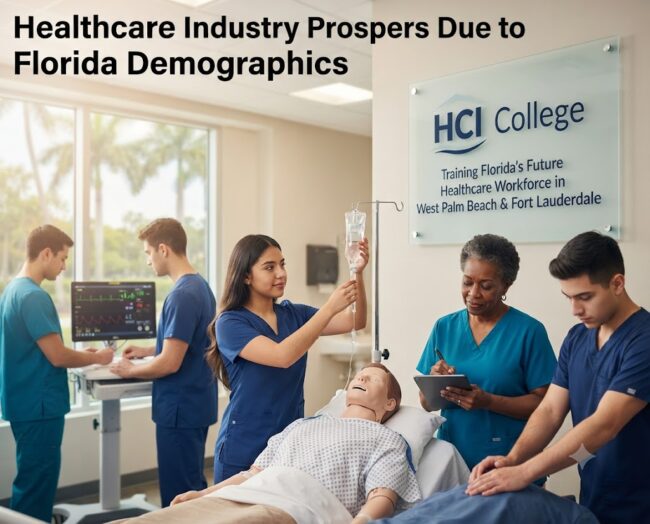
This is the demographic engine driving healthcare employment in Florida — and it is the reason a growing number of South Florida residents are enrolling in nursing and allied health programs. HCI College, an accredited institution with campuses in West Palm Beach and Fort Lauderdale, is among the schools preparing them.
Demographics as Destiny: Why the Demand Is Structural
Healthcare demand rises with age. This is not a trend or a preference; it is a clinical reality. Older adults experience higher rates of chronic conditions, require more frequent medical intervention, undergo more procedures, take more medications, and are more likely to need rehabilitative, long-term, or in-home care.
Florida has concentrated an unusually large share of that population within its borders — and the state has done so deliberately, building an economy and an infrastructure around it. Retirement communities, senior living developments, and 55-plus neighborhoods are woven throughout the state’s residential landscape. The healthcare system has grown to serve them.
But the picture is broader than retirees alone. Florida has also been among the fastest-growing states in the country by overall population, adding residents across every age bracket. Families relocate. Working-age adults arrive for employment. Each new resident enters the healthcare system as a patient — needing a primary care provider, an urgent care clinic, an emergency department on a difficult night, a specialist for a chronic condition.
Population growth means more appointments, more procedures, more occupied beds, and more staff required to deliver care.
There is a third force, and it may be the most consequential of the three: the healthcare workforce is aging alongside the population it serves. A substantial portion of experienced nurses is approaching retirement. Attrition and burnout have thinned the ranks further. Meanwhile, the training pipeline has not expanded quickly enough to replace them.
The result is a gap between the number of healthcare workers Florida needs and the number it has — a gap that has persisted for years and shows no indication of closing rapidly.
What a Long-Horizon Shortage Means for Job Seekers
Economists would classify this as a structural shortage rather than a cyclical one. The distinction matters enormously for anyone deciding whether to invest time and money in a healthcare credential.
A cyclical shortage corrects itself. Demand spikes, wages rise, workers flow in, equilibrium returns. A structural shortage persists because the underlying conditions producing it do not reverse. Florida’s population is not going to get younger. Retiree migration is not expected to stop. The nurses approaching retirement will, in fact, retire.
For prospective students, this changes the risk calculation. The concern with any career investment is timing — entering a field just as it peaks, credential in hand, only to find the opportunity has passed. Florida healthcare presents close to the opposite situation. The demographic forces creating demand are measurable, well-documented, and operating on a multi-decade timeline.
That durability also shapes the employment experience for those already in the field. When employers compete for workers, the competition surfaces in tangible ways: hiring incentives, scheduling flexibility, and tuition assistance for staff pursuing advancement. It also compresses the distance between finishing a credential and starting work, because facilities need people now rather than eventually.
The variety of settings reinforces the point. Licensed nurses in South Florida are employed across hospitals, outpatient clinics, surgical centers, rehabilitation facilities, long-term care communities, home health agencies, hospice programs, physician practices, and more. That breadth functions as a form of security in itself — a slowdown in one care setting rarely coincides with slowdowns across all of them.
Placeholder quote — to be reviewed, approved, or replaced by HCI College:
“The students we see today are asking harder questions than they did a decade ago,” said [NAME, TITLE], HCI College. “They want to understand why the demand exists, not just that it does. When you walk them through Florida’s demographics, the answer becomes obvious very quickly.”
The Care Settings Growing Fastest
Florida’s demographic profile does not merely increase healthcare demand in the aggregate; it shapes which kinds of care are needed most.
Long-term care and skilled nursing facilities serve residents whose needs have progressed beyond what family or independent living can accommodate. Rehabilitation centers support patients recovering from surgery, stroke, or injury — events whose frequency increases with age. Home health agencies deliver care to people who prefer to remain in their residences, an option many older Floridians actively choose. Hospice provides end-of-life care with dignity.
Each of these settings is staffed substantially by nurses, and each is directly downstream of the state’s age profile.
This has practical implications for students. It means the roles available are not limited to the fast-paced hospital environment that dominates popular imagination. A nurse in a long-term care facility builds sustained relationships with residents over months and years, working at a steadier rhythm. A home health nurse works with autonomy across a route of patients. A hospital nurse manages higher acuity in close coordination with physicians and specialists.
Different temperaments suit different environments — and Florida’s demographics have ensured that all of them are hiring.
Pathways Into the Field
South Florida residents entering healthcare generally select among three routes, each carrying a different timeline, scope of practice, and set of admission expectations.
Practical Nursing
A Licensed Practical Nurse provides direct patient care: monitoring vital signs, administering medications within scope, performing wound care, assisting patients with activities of daily living, documenting carefully, and coordinating with registered nurses and physicians.
Its defining advantage is accessibility. Practical Nursing is a diploma-level credential, meaning a four-year degree is not required. Students need a high school diploma or GED to enroll, and a passing NCLEX-PN score to become licensed. HCI College’s program runs 16 months, allowing individuals with no prior healthcare background to become licensed and employed in well under two years.
Given the demographic demand for bedside and long-term care, that timeline has driven considerable interest in Fort Lauderdale LPN training. Career-changers frequently weigh a Fort Lauderdale LPN training course against substantially longer degree programs and determine that the shorter route better fits their circumstances. Admissions advisors note that in selecting an LPN training school South FL offers, completion is the decisive factor — the only credential that produces a career is one the student actually finishes.
Registered Nursing
A Registered Nurse works with a broader scope: developing and managing care plans, performing more complex clinical procedures, supervising LPNs and nursing assistants, and frequently specializing in fields such as geriatrics, critical care, or surgery. Autonomy, responsibility, and earning potential are all higher.
The road is correspondingly longer. An associate degree is typically the minimum requirement, along with a passing NCLEX-RN score. Admission expectations are also greater; prerequisite coursework in anatomy and physiology is common, and many programs require a standardized entrance exam such as the TEAS.
Students who investigate Pre RN nursing classes Fort Lauderdale options in advance are building that foundation deliberately, rather than encountering a prerequisite gap partway through an application. For those whose ambitions include specialization — particularly in geriatric care, where Florida’s demographics guarantee sustained demand — identifying the appropriate RN school Fort Lauderdale provides is a logical focus of their research.
Allied Health
Not every prospective healthcare worker is drawn to nursing specifically. Medical assisting combines clinical responsibilities with administrative work and offers one of the shortest paths into a clinical environment. Individuals exploring medical assistant training Fort Lauderdale programs often do so to begin working with patients quickly, or to confirm the field suits them before committing to a longer nursing program.
Critically, these pathways interconnect. LPNs bridge to RN. Medical assistants transition into nursing. A first credential serves as a foundation rather than a ceiling — and in a labor-constrained industry, employers frequently contribute to funding an employee’s subsequent education.
Accreditation: The Condition Behind Every Other Consideration
None of this opportunity is accessible without a credential that the state recognizes — and that depends entirely on accreditation.
The distinction is worth stating plainly. A school awards a diploma or degree. The state grants the license. In Florida, the Board of Nursing determines whether a program’s graduates are eligible to sit for the NCLEX at all. A graduate of a program that does not qualify holds a document that cannot become a license, regardless of how much time or money was invested in obtaining it.
HCI College is accredited by the Accrediting Commission of Career Schools and Colleges (ACCSC) and licensed by the Florida Commission for Independent Education, with nursing graduates prepared for NCLEX eligibility.
Prospective students evaluating a Fort Lauderdale school for LPN training are encouraged to ask directly about NCLEX preparation and outcomes. When comparing Fort Lauderdale nursing training classes, students should also ask where clinical rotations take place and how many hours they will complete — clinical experience is what transforms classroom instruction into employable competence, and it is what hiring managers evaluate most closely.
Admissions, Cost, and Program Demands
Admission requirements at most Florida programs include a high school diploma or GED, a completed application and enrollment agreement, valid government-issued identification, immunization records, a physical examination, and a background check and drug screen prior to clinical rotations. Because instruction and the NCLEX are administered in English, comfort learning in English is essential.
Advisors consistently recommend initiating health and background clearances first. Those steps depend on external timelines — medical appointments, laboratory results, background reports — and represent the most common cause of a delayed program start.
Regarding cost, HCI College notes that financial aid is available to those who qualify, alongside scholarships, payment options, and career placement assistance for graduates. The institution’s practical nursing program includes required materials and a set of uniforms at no additional charge. Prospective students are advised to file the FAFSA if they intend to use federal aid and to request a net-price estimate rather than relying on published figures alone.
Programs are demanding by design, combining lectures, skills laboratories, and clinical rotations on a compressed schedule. Individuals considering LPN nurse training in Fort Lauderdale while maintaining employment are encouraged to raise scheduling directly with an admissions advisor early in the process, and to arrange transportation, childcare, and a study routine before coursework intensifies.
Campus Locations
HCI College operates two South Florida campuses, positioned to serve students across Palm Beach and Broward counties:
West Palm Beach (561) 586-0121 1764 North Congress Ave. West Palm Beach, FL 33409 (Corner of Congress Ave. and Westgate Ave.)
Fort Lauderdale (954) 626-0255 1201 W. Cypress Creek Rd. Suite 101 Fort Lauderdale, FL 33309
Residents of northern Palm Beach County researching Palm Beach Gardens LPN programs typically find the West Palm Beach campus most convenient, while those closer to Broward County generally select Fort Lauderdale. Students evaluating a school for LPN in Fort Lauderdale will find the Cypress Creek Road campus accessible from much of the county.
Because clinical rotations may occur at facilities separate from the campus itself, prospective students are encouraged to ask admissions staff where placements typically take place in order to plan the full logistics of attendance.
Looking Ahead
Florida’s demographic trajectory is among the most predictable in the nation. The population will continue to age. Retirees will continue to arrive. The existing healthcare workforce will continue to move toward retirement. Each of these trends operates on a timeline measured in decades, not quarters.
For students weighing where to invest their training, that predictability is itself the argument. The demand for nurses and allied health workers in Florida is not a bet on a favorable economy or an emerging technology. It is a reflection of who lives here, how old they are, and who will be arriving next.
About HCI College
HCI College is an accredited institution offering healthcare career training at campuses in West Palm Beach and Fort Lauderdale, Florida. Programs include Practical Nursing, an Associate Degree in Nursing, and Medical Assisting. The college is accredited by the Accrediting Commission of Career Schools and Colleges (ACCSC) and licensed by the Florida Commission for Independent Education. Financial aid is available to those who qualify, and career placement assistance is provided to graduates.
For more information, visit www.hci.edu, call the West Palm Beach campus at (561) 586-0121, or call the Fort Lauderdale campus at (954) 626-0255.
About Brian French
Led by a commitment to tech-intelligent curation, Brian French tracks and analyzes corporate developments and writes Press Releases on Florida's dynamic companies, leaders and economy. Brian brings an extensive financial background to his analysis, having graduated from the University of South Florida in Finance and serving as a Vice President and Portfolio Manager for Merrill Lynch Private Investors and the Trust Department in St. Petersburg, FL, as well as a Vice President and Trust Investment Officer for SunTrust Bank in Sarasota, FL. His writing blends macroeconomic trends, capital markets, corporate strategy, and modern digital insights for a sophisticated look at Florida's business market.