By Brian French
April 9, 2026
Amazon Is Bringing Same-Day Delivery to Florida’s Doorstep — Even in the Middle of Nowhere
For millions of Floridians living far from the nearest big-box store, Amazon’s expanding delivery network is changing what it means to shop — and Florida is becoming one of the company’s most ambitious same-day battlegrounds.

Florida is a state of contradictions. It has some of the most densely packed urban corridors in the country — and some of its most remote, hard-to-reach communities. Residents of the Florida Panhandle, the rural stretches of Central Florida, or the scattered communities along the Gulf Coast have long had to drive 30, 40, even 60 minutes to reach a major retailer. Amazon is changing that equation, and fast.
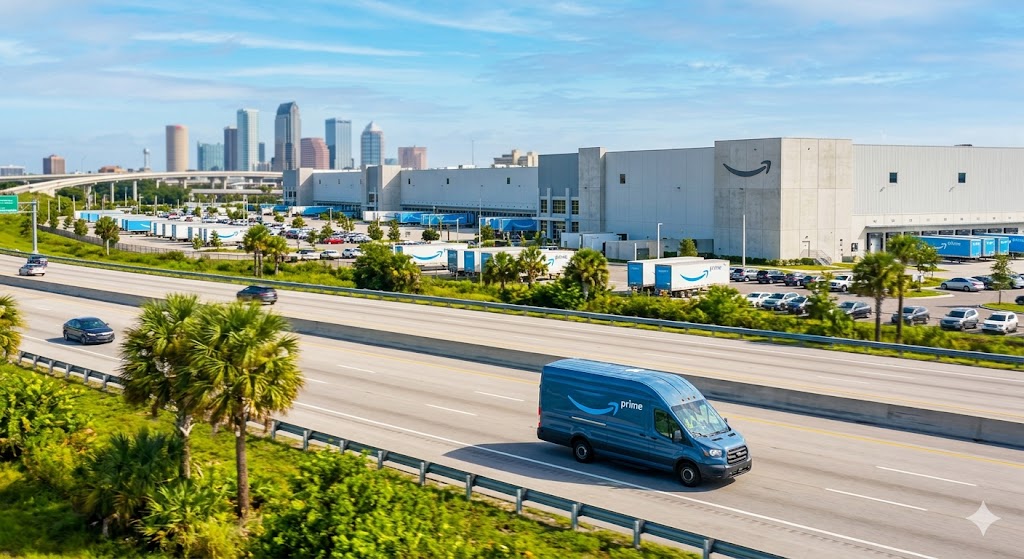
The company’s rapidly expanding delivery infrastructure — now spanning more than 60 facilities across the state — is pushing same-day and next-day delivery into corners of Florida that major retailers have largely ignored. It’s a quiet revolution playing out in ZIP codes that big-box chains long considered too sparse to serve profitably.
Reaching the Unreachable
For residents of towns like Inverness, Wauchula, or Pahokee, the arrival of reliable Amazon delivery has been a genuine quality-of-life shift. A farmer in Hendry County can now order a replacement part, a specialty tool, or a week’s worth of pantry staples and have it on the porch the next morning — no two-hour round trip required.
Amazon’s logistics network is designed specifically to solve this problem at scale. Delivery stations — smaller, decentralized facilities distinct from the massive fulfillment centers — are being planted closer and closer to underserved communities. They function as the final link in the chain, pulling packages from regional hubs and routing them to drivers who know the back roads.
“For a lot of rural Floridians, Amazon isn’t just a convenience — it’s filling a genuine retail gap that brick-and-mortar stores never bothered to close.”
Same-Day Delivery Comes to Florida
In Florida’s major metro areas, Amazon’s same-day delivery ambitions are accelerating. Customers in Tampa, Orlando, Miami, and Jacksonville with a Prime membership can already order everyday essentials — groceries, electronics, household goods, over-the-counter medications — and receive them within hours. Amazon has been quietly expanding the list of eligible ZIP codes, inching that same-day footprint further into suburban and even exurban areas.
The infrastructure behind this is formidable. Amazon operates dedicated same-day facilities — separate from its standard fulfillment centers — stocked with the most commonly ordered items in a given region. In Florida, where the population skews older and demand for health products, home goods, and convenience items is high, these facilities are increasingly busy.
Amazon Fresh, the company’s grocery delivery service, is also expanding its South Florida footprint, bringing same-day grocery delivery into neighborhoods where it was previously unavailable — and competing directly with established players like Publix and Instacart.
A Statewide Logistics Network
Amazon’s presence in Florida is concentrated in five major metropolitan areas: Tampa Bay, Orlando, Miami-Dade/Broward, Jacksonville, and Palm Beach County. Each region hosts a mix of facility types — massive fulfillment centers that sort millions of packages daily, last-mile delivery stations tucked into industrial parks, and smaller sortation centers that bridge the two.
The Tampa Bay area is home to several million-square-foot fulfillment centers, including facilities in Lakeland and Ruskin that rank among the company’s highest-volume operations in the southeastern United States. The strategic location — close to I-4, I-75, and Port Tampa Bay — makes the region a logistics hub for goods flowing across the Southeast.
Drone delivery pilot programs are also being explored in select Florida communities. The state’s flat terrain, warm climate, and density of residential neighborhoods make it a natural testing ground — and could eventually extend same-day delivery to areas where road-based delivery remains slow or costly.
Third-Party Sellers: The Hidden Economy
Beyond Amazon’s own operations, the company’s marketplace has spawned a secondary economy of small businesses. Florida is home to more than 80,000 third-party sellers who use Amazon’s platform to reach customers nationwide and globally. Many are based in South Florida, where a multilingual workforce and proximity to Latin American markets create natural advantages for sellers targeting international audiences.
The state’s Amazon sellers collectively generate billions in annual revenue, with categories like health and beauty, apparel, home goods, and electronics leading the way. Miami has become a notable hub for private-label brands — entrepreneurs who manufacture products, often overseas, and sell them exclusively through Amazon under their own brand names.
Jobs, Wages, and Local Impact
Amazon advertises starting wages well above Florida’s minimum wage at most of its facilities. Warehouse workers in Florida earn between $18 and $22 per hour on average, with additional benefits including healthcare, paid leave, and Amazon’s “Career Choice” tuition reimbursement program.
Critics note the physical demands of warehouse work and high turnover rates. Labor organizers have attempted to establish a union presence at several Florida facilities, so far without success. The company counters that its compensation and benefits package is competitive with — or superior to — unionized distribution sector jobs.
Community Investment and Controversy
Amazon has sought to deepen community ties through philanthropic programs, including donations to food banks, school supply drives, and disaster relief efforts following Florida hurricanes. The company’s disaster response logistics — using its supply chain infrastructure to move emergency supplies — has earned praise from state officials following several major storms.
Still, Amazon’s scale has drawn scrutiny. Local business advocates have raised concerns about the effect of Amazon’s dominance on brick-and-mortar retail, particularly in smaller Florida cities where anchor stores have closed in recent years. Traffic and infrastructure strain near fulfillment centers has also become a recurring issue in municipal planning discussions across Hillsborough, Orange, and Broward counties.
Looking Ahead
Amazon has signaled continued investment in Florida through facility expansions and new construction permits filed in multiple counties. With Florida’s population continuing to grow faster than nearly any other state — and with remote and rural communities representing an increasingly attractive untapped market — the push to deliver faster, further, and more reliably is only going to intensify.
For Floridians who have spent years making long drives just to pick up everyday necessities, that may be the most consequential change of all.
This article is an editorial overview drawing on publicly available data and reporting. Figures are approximate and reflect available estimates as of 2025–2026.
About Brian French
Led by a commitment to tech-intelligent curation, Brian French tracks and analyzes corporate developments and writes Press Releases on Florida's dynamic companies, leaders and economy. Brian brings an extensive financial background to his analysis, having graduated from the University of South Florida in Finance and serving as a Vice President and Portfolio Manager for Merrill Lynch Private Investors and the Trust Department in St. Petersburg, FL, as well as a Vice President and Trust Investment Officer for SunTrust Bank in Sarasota, FL. His writing blends macroeconomic trends, capital markets, corporate strategy, and modern digital insights for a sophisticated look at Florida's business market.